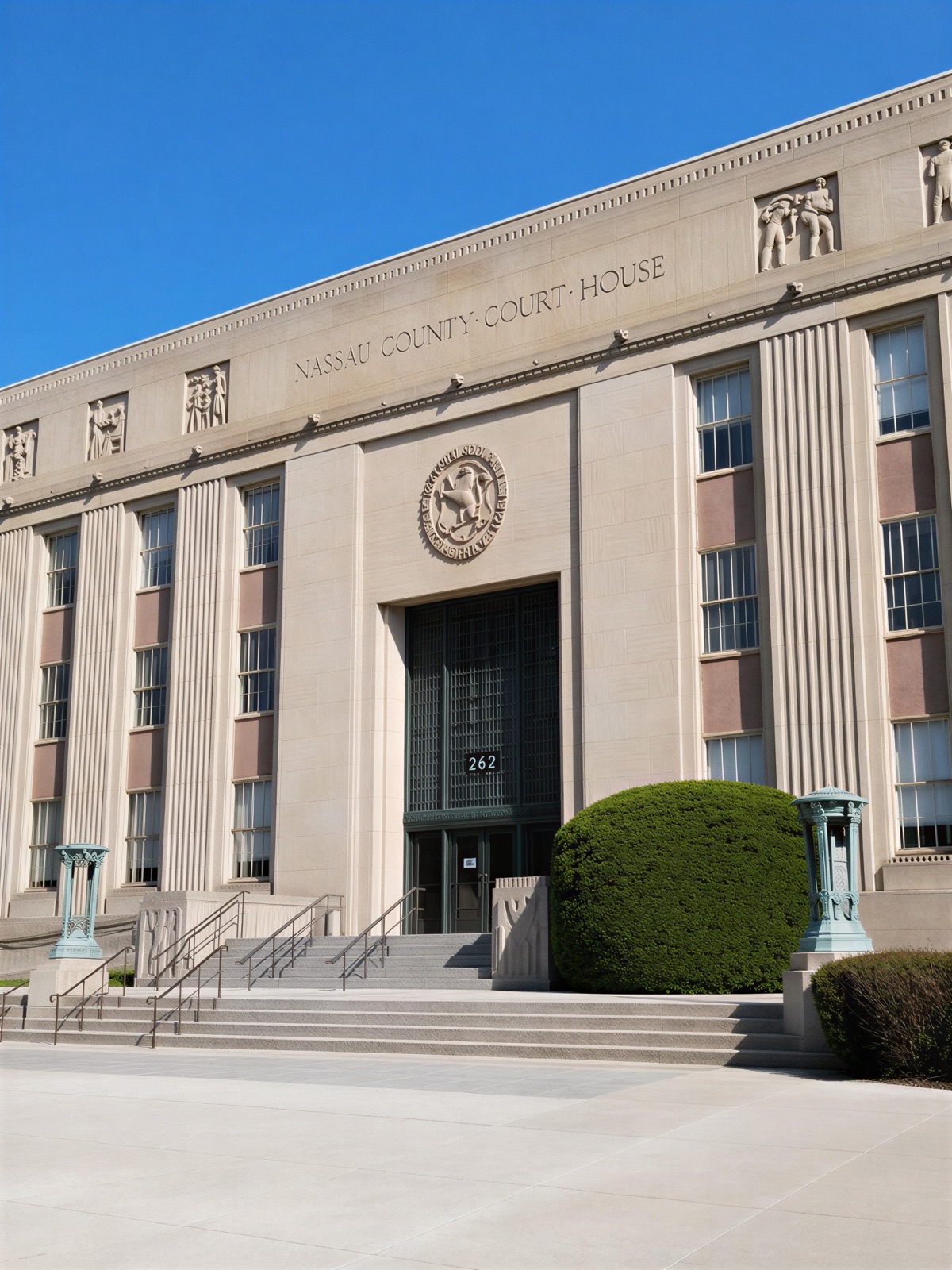
If you have been served with a petition, or you are the one filing, the first question is usually logistical: where do I go, and what happens when I get there? Below is the honest version — the part nobody puts on a court website.
Where it is
Nassau County Family Court is at 101 County Seat Drive in Mineola, in the county court complex just off Old Country Road. Our office is a few minutes away, which means we are in that building regularly.
It is not the same building as Supreme Court, which sits at 100 Supreme Court Drive in the same complex. People arrive at the wrong one often enough that it is worth checking your notice before you leave the house. The address you need is printed on it.
Give yourself more time than the drive requires. Parking in the complex fills up, and everyone entering passes through security.
What Family Court decides — and what it doesn't
This is the distinction that catches people out, and it matters more than the address.
Family Court handles custody and visitation, child support, paternity, family offense petitions, and guardianship. If your case is about where the children live, who makes decisions for them, or what support gets paid, that is Family Court.
Family Court cannot grant a divorce. In New York, only Supreme Court can do that. So if you are divorcing and there are children, your custody and support issues may be decided as part of the divorce in Supreme Court rather than in a separate Family Court case — and where your matter belongs is a real strategic question, not a clerical one.
It is common to have a Family Court case running before a divorce is filed, and then to have it folded into the divorce afterward. If you are in that position, know which court you are in and why.
What the day actually looks like
Expect to wait. Your notice gives a time, but courtrooms run multiple matters in the same slot, and cases ahead of yours can run long. The appearance itself is often short — sometimes only a few minutes — while the morning around it is not.
Bring photo identification. Bring the notice or petition you were sent, and any paperwork it asks for. If you have a lawyer, meet them outside the courtroom before you go in rather than in the hallway at the last minute.
On a first appearance, a great deal is often procedural: confirming who is present, whether anyone needs an attorney assigned, what has to be exchanged, and when everyone comes back. If you expected a decision that day and left without one, that is normal and not a sign the case is going badly.
Bring a book or something to occupy you, and if you can avoid bringing your children, do. Childcare is not provided, and a courthouse is a long, dull day for a child at best.
The mistake people make most often
Not lateness, and not what they wear. It is walking in without knowing what is actually being decided that day.
Parents arrive expecting a judge to hear the whole story and rule. What is usually in front of the court is much narrower — a temporary arrangement, a schedule for exchanging information, a single disputed question. In the pressure of the moment, people agree to things they have not thought through, because they assume it is provisional or because they want the day to be over. Temporary orders have a way of becoming the baseline everyone argues from later.
Before any appearance, you should be able to say in one sentence what is being asked for, what you want instead, and what you can live with. If you cannot, that is the conversation to have before the date — not in the hallway outside the courtroom.
How to conduct yourself
Dress as you would for a job interview. Turn your phone off, not to silent. Address the judge as "Your Honor," speak only when it is your turn, and do not react to what the other side says — the court notices, and it rarely helps you.
If emotion gets the better of you, that is human and judges have seen it. What they weigh more heavily is whether a parent can keep the conflict away from the child. That impression starts forming in the courtroom.
Do you need a lawyer?
You are permitted to appear without one. Whether you should is a different question, and it depends on what is at stake and whether the other side has counsel.
An appearance where both parents are unrepresented and broadly agree is very different from one where the other side has a lawyer and you do not. The imbalance shows up not in dramatic moments but in small ones — what gets asked for, what gets agreed to, what ends up in the order.
Mitchell A. Greebel has appeared in the Nassau County courthouses since 1984. If you have a date coming up and you are not sure what it is for, that is exactly the kind of question a free consultation is for.
Have an appearance scheduled? Call 516-248-7008 for a free, confidential consultation — or request one online.
This article is general information about New York practice, not legal advice, and it does not create an attorney-client relationship. Court procedures change. Always check your own notice and speak with an attorney about your situation. See our Terms of Use.